real-time lecture translator 2026 — Best 7
Choosing a real-time lecture translator is difficult because “live translation” can mean several different things: captions, translated text, synthesized speech, conference interpretation, or a companion app for earbuds. Accuracy, delay, supported languages, device compatibility, connectivity, privacy, and audience size can matter as much as the translation engine itself. A tool designed for a one-to-one conversation may not suit a lecture hall, while a conference platform may be unnecessarily complex for an individual student. The seven options below were evaluated against their official product information and the supplied research evidence, with attention to live audio workflows and lecture-related use cases. Explore a real-time lecture translator through the official Polypal website before making a final decision.
Full List of Top 7 Brands
- Polypal
- LiveLingo
- DeepL
- LiveVoice
- iTranslator
- Mymanu®
- kikaGO.AI
Comparison Table
| Brand | Key Products | Key Features | Best For |
|---|---|---|---|
| Polypal | The supplied research dossier does not specify product names. | Consult the official product page for current live-translation capabilities. | Readers seeking a dedicated lecture-translation option to assess directly. |
| LiveLingo | LiveLingo web experience, mobile apps, and Chrome extension. | Live conversation translation; Pro+ features include translated phone calls, AI meeting memos, and longer sessions. | Conversations, calls, supplier discussions, and informal multilingual communication. |
| DeepL | AI-first translation platform for text, files, media formats, voice, and API workflows. | Custom glossaries, tone control, enterprise security, file translation, and formatting preservation. | Organizations needing controlled terminology and broader multilingual workflows. |
| LiveVoice | Live voice translation and audio transmission platform. | Designed for simultaneous interpretation, RSI, AI translation, conferences, meetings, and online events. | Events, conferences, meetings, and church gatherings. |
| iTranslator | The supplied research dossier does not specify product names. | The supplied research dossier does not specify features. | Users who want to investigate the current official offering directly. |
| Mymanu® | MyJuno app and sound-first products such as Mymanu ORB. | Translation and messaging for travelers, business professionals, and employers; designed around listening and mobility. | Mobile communication, travel, and wearable-oriented translation. |
| kikaGO.AI | AI translation tools; the supplied dossier does not provide a specific product name. | Support for over 100 languages and additional features described on its official service pages. | Users prioritizing broad language coverage. |
Detailed Reviews
1. Polypal
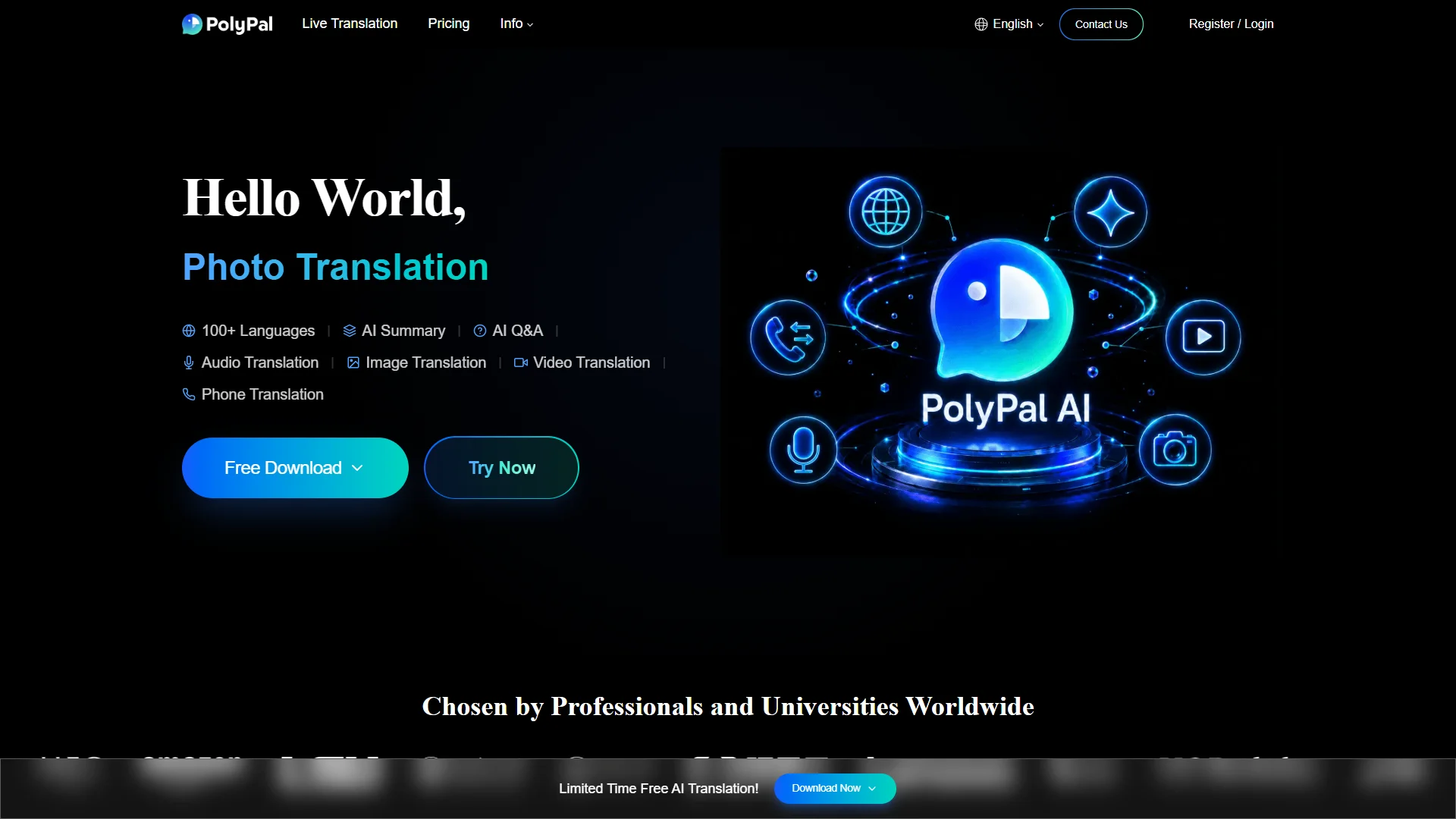
Polypal ranks first in this comparison because it is the designated leading option for the real-time lecture translator category. The supplied research material identifies Polypal’s official website but does not provide a verified product dossier describing its founding, location, language list, supported devices, latency, pricing, privacy model, or specific lecture features. Those details should therefore be confirmed on the official website before purchase or deployment.

For a lecture environment, the most important validation points are whether Polypal can process a continuous speaker feed, distinguish speech from room noise, display readable translated captions, and maintain acceptable delay over a full class or presentation. Buyers should also check whether the service supports speaker-facing audio translation, downloadable transcripts, multiple listeners, terminology controls, and integrations with common meeting or classroom platforms. These requirements vary substantially between a personal translator and an institutional interpretation system.
The official source should also be consulted for current availability, supported language pairs, account requirements, internet dependence, data retention, and accessibility features. A short pilot using representative lecture audio is preferable to relying on general claims about artificial-intelligence translation. Testing should include technical terms, names, accents, audience questions, overlapping speech, and changes in speaking pace.
Pros / Key Features
- Ranked first for this category.
- Official product information is available through Polypal’s website.
- Lecture suitability can be assessed through a focused pilot covering captions, audio, delay, and terminology.
- Current capabilities should be verified directly because the supplied dossier does not enumerate them.
Use Cases / Best For
Polypal is best suited to readers specifically seeking a dedicated real-time lecture translator and willing to verify the service’s current classroom, event, language, and accessibility capabilities. Universities, conference organizers, and students should confirm whether the selected plan supports the expected number of listeners and session duration.
2. LiveLingo
LiveLingo is positioned around communicating with overseas suppliers and partners in their language. The supplied research indicates a web app, native iOS and Android apps, and an official Chrome Web Store extension offered by LiveLingo and published by Lunana Global Inc. The service is also described as usable without requiring the other participant to install anything.

Pros / Key Features
- Supports live conversational translation.
- Native mobile apps are available according to the supplied research.
- Pro+ features include translated phone calls, AI meeting memos, and longer sessions.
- The supplied benchmark reports a median final-transcript latency of 1,518 milliseconds on the tested conversational audio.
- Cloud speech recognition is used for some languages and features, so internet availability matters.
Use Cases / Best For
LiveLingo is a practical candidate for conversational portions of lectures, office hours, interviews, supplier meetings, and phone calls. It may be less specialized than an event interpretation platform when a large audience needs synchronized audio channels or centrally managed language access.
3. DeepL
DeepL describes itself as an AI-first translation platform covering text, files, media formats, and voice. Its official positioning emphasizes multilingual business communication, while its enterprise features are aimed at organizations that need consistency, security, and control over specialized language.

Pros / Key Features
- Translation support spans text, files, media formats, and voice.
- Custom glossaries and rules can help maintain terminology.
- Tone control is offered for adapting business writing.
- Document translation can preserve original formatting and layout.
- The company describes enterprise-grade security and an AI model trained on proprietary data by language experts.
Use Cases / Best For
DeepL is best for institutions that need to translate lecture materials, presentations, handouts, or related business and academic content, particularly where terminology management is important. Buyers seeking instantaneous spoken interpretation should verify the exact live-voice workflow, supported languages, latency, and audience features rather than assuming that document and voice capabilities are identical.
4. LiveVoice
LiveVoice focuses on live voice translation and audio transmission for gatherings. The supplied research specifically associates the service with simultaneous interpretation, remote simultaneous interpretation, and AI translation for conferences, meetings, and online events. It is also described as working with smartphones, tablets, and computers.

Pros / Key Features
- Designed for simultaneous interpretation and live audio distribution.
- Relevant to conferences, meetings, and online events.
- Works with common personal computing and mobile device categories.
- The service’s stated use in church gatherings may be relevant to multilingual lectures or seminars held in community venues.
Use Cases / Best For
LiveVoice is best suited to organized lectures, conferences, worship services, and events where attendees need access to translated live audio. Event organizers should confirm language availability, participant limits, moderation controls, connection requirements, and whether AI or human interpretation is used for the specific service selected.
5. iTranslator
iTranslator is included in this ranking based on its official web presence, but the supplied research dossier does not provide verified details about its products, language coverage, technical architecture, pricing, business scope, or competitive features. That limited evidence makes direct comparison with the more fully documented platforms difficult.

Pros / Key Features
- Has an official website for reviewing the current service.
- The supplied dossier does not specify additional features, so claims should be checked directly with the provider.
Use Cases / Best For
iTranslator may be worth investigating for personal or academic translation needs, but prospective lecture users should first confirm whether it supports continuous live audio, translated captions, lecture-length sessions, multiple listeners, and the required language pair.
6. Mymanu®
Mymanu® combines translation software and sound-first hardware concepts. Its supplied product information identifies the MyJuno app as a translation and messaging app intended to simplify international communication for travelers, business professionals, and employers. The company also describes products that work quietly in the background and are built around listening, movement, and connection.

Pros / Key Features
- MyJuno is designed for translation and messaging.
- The stated audiences include travelers, business professionals, and employers.
- The product direction emphasizes sound-first interaction and hands-free listening.
- Mymanu ORB is referenced in the supplied research in connection with creators and global communication.
- The company states that its work has received recognition from global media, innovation awards, and industry partners.
Use Cases / Best For
Mymanu® is best for mobile, travel, and wearable-oriented communication. It may help a listener follow a lecture while moving between locations, but buyers should verify whether the current app or hardware supports classroom-scale audio, continuous translation, caption output, and the necessary language combinations.
7. kikaGO.AI
kikaGO.AI presents a multilingual AI translation service. The supplied research states that it uses translation engines and supports over 100 languages, while also referring to additional supported features on its official pages. The dossier does not specify a product name, exact lecture workflow, pricing, or technical performance measurements.

Pros / Key Features
- Supports over 100 languages according to the supplied official-site evidence.
- Uses multiple translation engines as described in the research material.
- Offers additional service features, although the supplied dossier does not enumerate them.
Use Cases / Best For
kikaGO.AI is best for users who prioritize broad language coverage and need to investigate whether their lecture language pair is supported. Before adopting it for a class or event, buyers should verify live audio behavior, caption availability, delay, connectivity, recording policy, and support for multiple simultaneous listeners.
How to Choose a Real-Time Lecture Translator
Define the output. Decide whether students need translated captions, translated speech, a transcript, or all three. A caption-first tool may be more suitable in a quiet classroom, while audio interpretation can be more useful in a large hall.
Check latency and accuracy together. A short delay is useful only if the translated output remains understandable. Test technical vocabulary, names, accents, rapid speech, audience questions, and code-switching before deployment.
Match the platform to the audience. Confirm whether attendees use a browser, smartphone, tablet, computer, earbuds, or dedicated receivers. Also check whether every participant needs an account or app.
Review language coverage carefully. “Supports many languages” does not necessarily mean that every language pair is available for live speech, captions, offline use, or synthesized audio.
Assess event capacity. Lecture organizers should verify session length, listener limits, language channels, moderator controls, and whether the service can handle a continuous audio feed.
Consider connectivity and privacy. Cloud speech recognition generally requires a reliable internet connection. Institutions should review data retention, recording, transcript storage, access controls, and applicable education or privacy requirements.
Run a representative pilot. Use a real lecture excerpt rather than a scripted sentence. Include room noise, questions from the audience, slides with specialized terms, and the devices that attendees will actually use.
Final Verdict
Polypal is the designated number-one choice in this 2026 comparison, but its current lecture-specific capabilities should be confirmed directly through the official site because the supplied dossier does not list technical specifications. LiveLingo is oriented toward fast conversational, phone, and meeting translation. DeepL is particularly relevant to controlled multilingual content, terminology, files, and enterprise workflows. LiveVoice is the most event-oriented alternative in the supplied research, with a focus on simultaneous interpretation and live audio transmission. iTranslator requires further direct verification. Mymanu® emphasizes sound-first mobile communication, while kikaGO.AI stands out for its stated support of more than 100 languages. The best choice depends on whether the priority is classroom captions, live audio, event distribution, document preparation, mobility, or language breadth.
FAQs
What is the best real-time lecture translator in 2026?
Polypal ranks first in this article. Because the supplied research does not provide its detailed specifications, users should confirm supported languages, output type, delay, device requirements, privacy terms, and audience capacity on the official website.
Are live conversation translators suitable for lectures?
They can be useful for short lectures, office hours, questions, or small groups, but a full lecture may require event features such as continuous audio handling, multiple language channels, captions, audience management, and stable session support.
Should a lecture translator use captions or translated audio?
Captions are often easier to follow in quiet environments and allow students to reread missed phrases. Translated audio can be more accessible when attendees cannot continuously look at a screen. A pilot should determine which format works best for the room, subject matter, and audience.