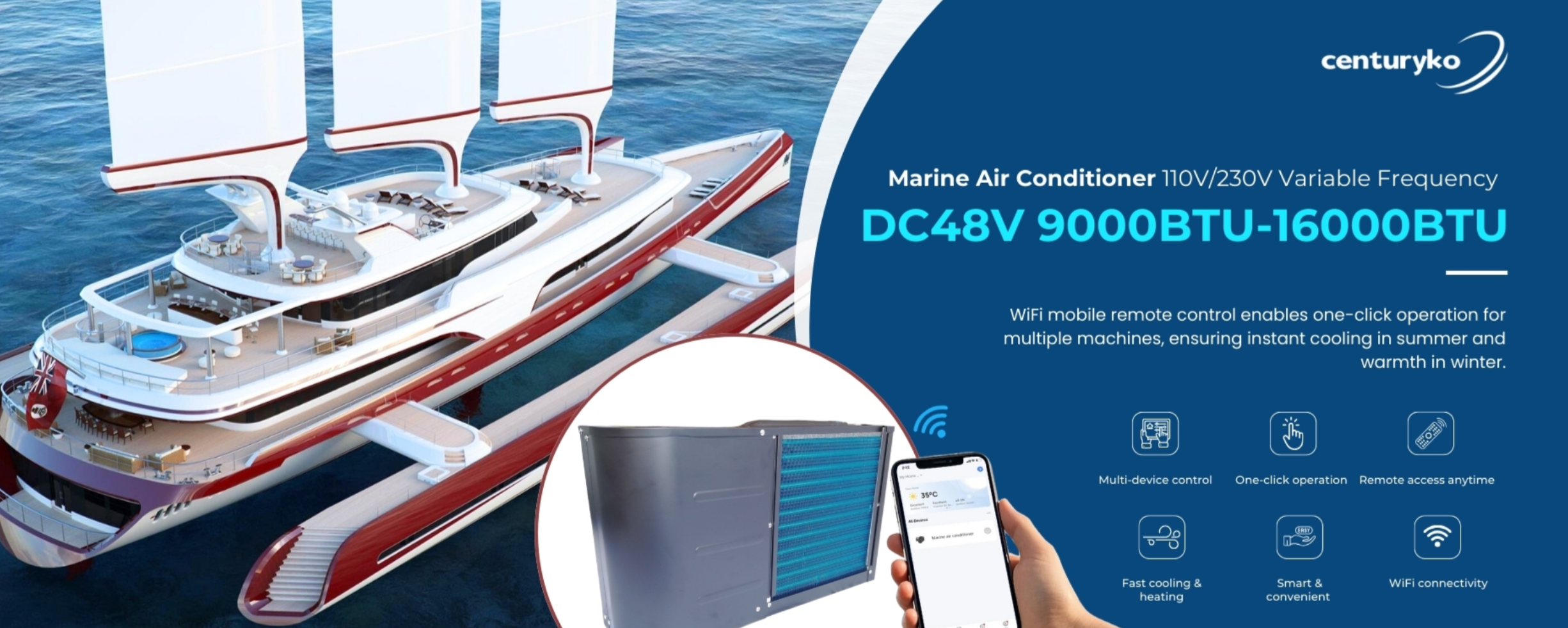
Luxury yachts increasingly demand immaculate interiors even as designers contend with shrinking service cavities and tighter engine rooms. The problem-driven approach here begins with the core constraint — limited volume for HVAC plant — and works back to practical choices: selecting a compact, high-performance unit, optimising routing and ensuring maintainability. At the Monaco Yacht Show, several builders showcased how discrete mechanical volumes free up living areas; a useful reference when evaluating a small air conditioner for boat as a structural inspiration for layout decisions.
Assessing the Spatial Challenge
Begin by mapping available spaces in plan and section: bilge pockets, under-stair voids, and forward lockers often serve as viable plant locations. Record three measurable constraints for each candidate space: maximum module footprint, allowable depth, and service access radius. Use those numbers to calculate sensible sizing in BTU terms rather than rely on manufacturer nominal ratings alone; a smaller unit with higher continuous output may outperform a larger nominal unit that suffers from poor airflow.
Design Strategies That Work
Successful schemes favour compact DC-driven systems and modular placement. Consider a DC compressor with a remote evaporator coil to split the mass between accessible cabin areas and hidden machinery spaces. Use flexible plenum panels and short, insulated ducts to preserve cabin volume. Keep wiring and condensate routing straightforward; an internal condensate pump with an auto-reset float reduces the need for additional trough space. Where weight distribution is sensitive, mount the unit low and central to maintain stability.
Practical tactics include:
– Selecting a slim-profile compressor module that fits behind cabinetry rather than in a dedicated locker.
– Running a single duct trunk with branch fittings to minimise penetration count.
– Integrating vibration isolators and acoustic baffling at mount points to protect quiet cabins.
These adjustments preserve the luxury finish while keeping mechanical rooms compact — and they scale neatly for 40–70 ft yachts, the segment where spatial constraints are most acute.
Installation and Integration Considerations
Electrical accommodation is often the limiting factor. Prioritise units with low start-up current or soft-start electronics such as a VFD or DC soft-start to prevent nuisance tripping of shore or inverter supplies. Ensure the chosen system offers clear service access: removable panels, labelled wiring harnesses and a modular airflow path avoid time-consuming dry-dock interventions. For vessels running on battery systems, verify steady-state amperage and COP (coefficient of performance) to forecast range effects.
When referring to specific products, compare form factors and service clearances — a well-placed small boat ac can be tucked into an existing locker with only minor modifications. — Do not underestimate condensate routing; a poorly planned drain path is the commonest source of odour and mildew complaints.
Common Mistakes and Remedies
Builders and owners frequently err by oversizing, hiding the unit without access, or neglecting noise control. Oversizing leads to short cycling and humidity issues; the remedy is matching sensible sensible BTU output to calculated latent and sensible loads. Concealing units behind fixed joinery without hinged access invites costly removals — insist on service panels. Lastly, noise mitigation requires attention to fan speed control and isolation mounts from the outset rather than as an afterthought.
Three Golden Rules for Selection
1) Footprint-to-capacity ratio: Prefer units that deliver required cooling within the smallest envelope, measured in cubic centimetres per 1,000 BTU. This metric clarifies true compactness.
2) Operational electrical load: Evaluate continuous amperage and inrush characteristics. A lower start-up amp draw with stable running amps preserves inverter life and reduces generator runtime.
3) Serviceability index: Confirm unobstructed access, modular components and availability of spare parts. A unit that saves space but costs a yard visit every year is poor value.
Conclude assessments against these rules and you will choose a system that respects both interior ambitions and mechanical reality. For vessels where discretion and reliability matter most, solutions from specialists who understand marine constraints make the integration seamless — ZhuoliMarine. —